viernes, 13 de junio de 2014

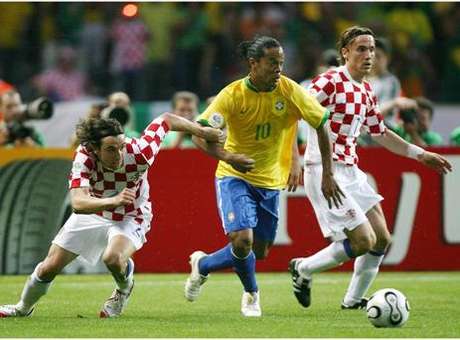
Brazil 3, Croatia 1: World Cup match report

Neymar rescued a nervy Brazil in the opening match of the 2014 FIFA World Cup, scoring two goals in a 3-1 comeback win over Croatia. 
An own goal by Marcelo gave the Croatians a shocking 1-0 lead early on, but Neymar evened the score in the first half and scored the winner off a penalty kick in the 71st minute. Oscar added an insurance marker in injury time to cap an excellent performance of his own. 

Key play

A frantic Brazil threw men forward after Marcelo’s unlucky own goal in the 11th minute, and finally gained the lead 20 minutes from full-time, when Neymar scored his second goal of the match.
Croatia has a right to feel slighted. It was a dubious call from Japanese referee Yuichi Nishimura. Croatian defender Dejan Lovren was jostling with Brazil’s Fred when the latter seemed to fall of his own accord. But Nishimura pointed to the spot, gave Lovren the yellow card, and Neymar cooly blasted the ball past Stipe Pletikosa for the match winner. 

Man of the match

Neymar. The man with the most pressure on his shoulders at the World Cup delivered when his country needed him the most, and that means good things for the hosts.  

Overall entertainment rating

4/4. We knew Brazil would come out firing, but full marks to Croatia for coming right at the Selecao with furious counterattacks. The Croatians’ opening goal ensured the match had a massive amount of tension. Brazil had the run of play, but both teams had chances moving forward, and Croatia had great opportunities to tie the match in the final 10 minutes.


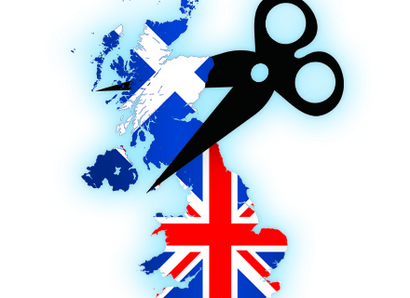
Only a Few Will Decide on What Could Be a Big Shift for Britain

President Obama has had his say, albeit couched in diplomatic caveats, and so, too, has J.K. Rowling, implying that her repertoire of wizards, villains and sundry spell-makers would also take a view if they could on Scotland’s independence.
But, as the days tick away toward a referendum on what Scots think about their future ties to the United Kingdom, three large groups of interested parties are conspicuously absent from the debate — the English, the Welsh and the (Northern) Irish.
On Sept. 18, people resident in Scotland and over the age of 16 will answer a simple question: “Should Scotland be an independent country?”
The consequences are potentially breathtaking: for the first time in 307 years, Scotland could break away; the United Kingdom could be not so united; Great Britain could be somewhat less great, geographically at least; Scotland could be free in a brave new world.
Last week in Brussels, President Obama departed from America’s vaunted neutrality in the debate to say that, while it was “up to the people of Scotland” to determine their destiny, “we obviously have a deep interest in making sure that one of the closest allies we will ever have remains a strong, robust, united and effective partner.”
 
The vote will be closely watched by other Europeans eyeing independence — the Catalans in Spain, for instance. It might even inspire thoughts further afield — in the Middle East, perhaps, where the debate over a two-state solution is far more intractable.

Know more about this new clicking  here: http://www.nytimes.com/2014/06/13/world/europe/scottish-independence-vote-cuts-england-wales-and-northern-ireland-out-of-the-equation.html?ref=world&_r=0
 

jueves, 12 de junio de 2014

Ukraine says 'Russian tank incursion' unacceptable

Ukrainian President Petro Poroshenko has told President Vladimir Putin that reports of Russian tanks moving into Ukrainian territory are unacceptable.

Ukraine's interior minister said earlier that three tanks had entered rebel areas of the east, and fighting was under way.

Arsen Avakov said that the tanks entered Ukraine along with other armour through a border checkpoint controlled by rebels in the Luhansk region.

Russia denied the report.

It said it was "another fake piece of information".

Moscow has accused President Poroshenko of not delivering on his earlier pledge to stop fighting in the east. It wants an investigation into allegations that Ukrainian forces used banned incendiary bombs against civilians.

Rebel fighters in Snizhne, eastern Ukraine, 12 June
Rebel fighters could be seen in Snizhne on Thursday

"The lack of any progress whatsoever in efforts to stop the violence and halt military operations... is causing increasing concern," Russian Foreign Minister Sergei Lavrov said.

He said that reports in the Russian media that incendiary bombs were being used was another "cause for special concern".

The bombs are designed to trigger major firestorms and were often used during the Vietnam War before they were banned by the United Nations.

Ukraine has denied using the weapons. It has accused Russia of allowing the rebels to deploy three Soviet-era T-72 tanks across the border into the east of the country.

Ukraine's presidency said in a statement that Mr Poroshenko, who was elected last month, had a "substantial" conversation by telephone with Mr Putin on Kiev's plan of bringing peace to the east.

miércoles, 11 de junio de 2014

This year's World Cup will be play out on Twitter, Facebook, Instagram and WhatsApp as it progresses in Brazil


On Tuesday, the world's biggest online social network is adding new features to help fans follow the World Cup - the world's most widely viewed sporting event - which takes place in Brazil from June 12 to July 13.
Facebook users will be able to keep track of their favourite teams and players throughout the tournament in a special World Cup section, called “Trending World Cup.”

Available on the Web as well as mobile devices, the hub will include the latest scores, game highlights as well as a feed with tournament-related posts from friends, players and teams.

In addition, an interactive map will show where the fans of top players are located around the world. 
Facebook has recently focused on making its mobile app usable on simple phones that use slower data speeds since many of its newest users are in developing countries.
http://www.northjersey.com/polopoly_fs/1.601929.1395732286!/fileImage/httpImage/image.jpg_gen/derivatives/box_650/052113twitter-dngnk.jpg
As a result, Rebecca Van Dyck, head of consumer marketing at Facebook, said the World Cup hub will also be available on so-called “feature phones.” Facebook, earlier this year, began displaying trending topics to show users the most popular topics at any given moment. The feature is currently available in the US, UK, India, Canada and Australia.
“This is our first foray into this, especially for a big sporting event like this,” Van Dyck said. 
Not to be outdone, Twitter touted in a blog post last week that the “the only real-time #WorldCup global viewing party will be on Twitter, where you can track all 64 matches, experience every goal and love every second, both on and off the pitch.”
http://cdn2.winknews.com.s3.amazonaws.com/media/worldcup2014L.jpgFans can follow individual teams or players and use the hashtags #WorldCup to tweet about the matches, and follow official accounts such as (at)FIFAWorldCup, (at)ussoccer for the United States team and (at)CBF-Futebol for Brazil's soccer governing body, for example. Clicking on the #WorldCup or #WorldCup2014 hashtags, meanwhile, will take you to Twitter's hubs for the event. 


martes, 10 de junio de 2014

Sunni Militants Drive Iraqi Army Out of Mosul

The  Iraqui soldiers abandoned their weapons and fled the northern Iraqi city of Mosul on Tuesday, as Sunni militants freed hundreds of prisoners and seized military bases, police stations, banks, the airport and the provincial governor’s headquarters. The attacks widened the Sunni insurgency in Iraq and were among the most audacious assaults on the government since the American military withdrawal more than two years ago.


The rout in Mosul, the second-largest Iraqi city after Baghdad and an important center of the country’s petroleum industry, was breathtaking in its speed and appeared to take government officials by surprise, not to mention residents of the city and surrounding Nineveh Province. A major humiliation for the government forces in Iraq’s Sunni-dominated areas, the defeat also reflected the stamina of the Sunni insurgency, which has been growing with the war in neighboring Syria.

Mosul was the last major urban area of Iraq to be pacified by American troops before they left, and the violence there now threatens to broaden into the adjacent oil-rich region of Kirkuk and autonomous Kurdish region of northern Iraq, which has its own armed forces, the peshmerga. There were unconfirmed reports late Tuesday that Sunni militants, flush with victory in Mosul, had overrun parts of Kirkuk to the southeast as soldiers and police officers abandoned their posts.

martes, 3 de junio de 2014

Hospital Charges Surge for Common Ailments

Charges for some of the most common inpatient procedures surged at hospitals across the country in 2012 from a year earlier, some at more than four times  the national rate of inflation, by Medicare officials on Monday.

While it has long been known that hospitals bill Medicare widely varying amounts — sometimes many multiples of what Medicare typically reimburses — for the same procedure, an analysis of the data by The New York Times shows how much the price of some procedures rose in just one year’s time.

Experts in the health care world differ over the meaning of hospital charges.


In order to know more information about this interesting news click here http://www.nytimes.com/2014/06/03/business/Medicare-Hospital-Billing-Data-Is-Released.html?hp

LAS VENTAJAS DE LA GLOBALIZACION

  • Permite llegar a un mercado mundial, lo que aporta grandes beneficios para las empresas y para los consumidores, quienes pueden disponer de mayor variedad de productos y de menores precios en muchos artículos.
  • La globalización ofrece oportunidades de crecimiento económico que han sido aprovechadas por distintos países; y, aunque este crecimiento no implica un beneficio directo para toda la población, abre esperanzas de una mejora en sus condiciones de vida.
  • La globalización y sus instrumentos (internet, los sistemas de telecomunicaciones...) acercan a personas, pueblos y culturas.
  • La globalización conlleva mayor cooperación entre los gobiernos y las instituciones para solucionar problemas mundiales, como la pobreza, el deterioro del medio ambiente o las guerras  
  • La mayor difusión de los conocimientos científicos e innovaciones tecnológicas ha permitido que las personas se beneficien con adelantos en el área de la salud o accedan a productos que facilitan la vida cotidiana, la educación o el trabajo. 
  • La creciente interconexión y la información al instante permiten que la comunidad internacional pueda ayudar más rápidamente en caso de una catástrofe natural o un problema humanitario.
  • Aumenta el empleo en los lugares donde llegan las multinacionales, especialmente en los países subdesarrollados.
  • Aumenta la competitividad entre los empresarios y se eleva la calidad de los productos.
  • Se descubren e implementan mejoras tecnológicas que ayudan a la producción y a la rapidez de las transacciones económicas.
  • Mayor accesibilidad a bienes que antes no se podían obtener en los países subdesarrollados.